There is a particular category of artists that art history has treated with the polite distraction reserved for things no one quite knows where to place. Hilma af Klint belonged to this category — or rather, she occupied it for nearly a century, until the world decided it was finally ready to look at what she had painted in 1906.
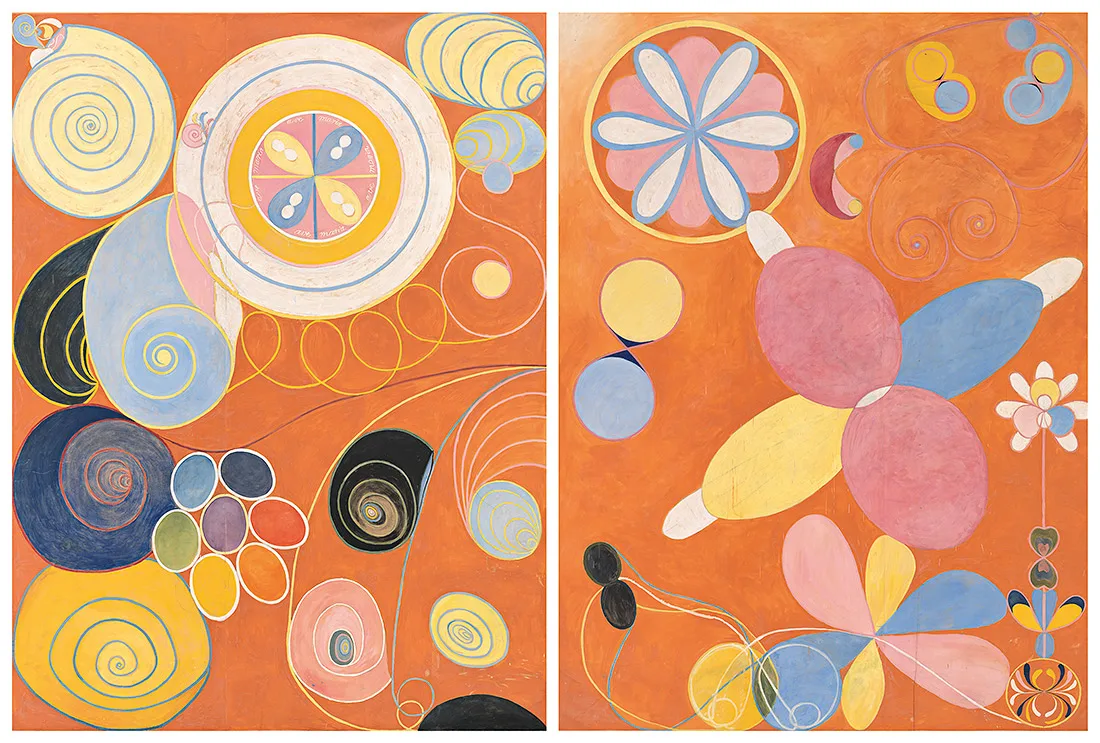
The record is now documented and difficult to contest. In 1906, af Klint began painting abstract compositions — nonrepresentational geometric and organic forms — predating the first forays into abstraction by Kandinsky, Mondrian, and the other leading candidates for the title. Between November 1906 and March 1907, she painted the Primordial Chaos series: small-format canvases combining geometric shapes such as spirals with dynamic brushstrokes, letters of the alphabet and symbols, breaking entirely free from representation. These were the first works of the monumental cycle she would call Paintings for the Temple, which would eventually comprise 193 works completed between 1906 and 1915.
The question of priority — who painted the first abstract work — is one that art history has handled with a curious combination of enthusiasm and evasion. Kandinsky claimed to have created the first abstract painting in 1911, while af Klint had in fact preceded him by five years. Many researchers now believe Kandinsky may have backdated one of his abstract watercolors, signing it "1910," to claim credit for being the first abstract artist in modern art history, unaware of af Klint's work entirely. His celebrated manifesto On the Spiritual in Art, published in 1911, laid out a theoretical framework for non-representational painting rooted in Hegelian aesthetics and quasi-mystical concerns about color and inner necessity. Mondrian, for his part, explored abstraction throughout the 1910s, explicitly writing about his process and creating works that, over the course of the decade, gradually rejected representation in favour of complete abstraction. Both men wrote manifestos. Both men built movements. Both men secured their place in the canon through a combination of artistic production and institutional visibility.
Af Klint did none of these things. Without knowing of each other's existence, af Klint and Kandinsky seem to have travelled a long way on the same tracks. Klint arrived before Kandinsky. But she left no manifesto, sought no gallery, built no school. She told almost no one. What separates her from her contemporaries is not talent — the works make that argument redundant — but a complete indifference to the machinery of recognition. Kandinsky theorised abstraction into existence; af Klint simply painted it, in a studio in Stockholm, in the winter of 1906, and then said nothing.
This silence has consequences that reach beyond biography. It raises a structural question about how art history is constructed — not only who makes art, but who claims it, who explains it, and who is present in the rooms where reputations are decided. The early twentieth century avant-garde was a remarkably well-documented social network: manifestos, letters, exhibitions, polemics, allegiances. Af Klint had no contact with the modern movements of her time. She was working in a different register entirely — not against the establishment, but orthogonal to it, in a space the establishment had not yet mapped.
Group IV — The Ten Largest (1907) — is perhaps the most immediately striking demonstration of what that space contained: ten tempera paintings on paper, each over three meters tall, moving the viewer through the stages of life with a formal syntax that has no documentable precedent in Western painting. The Swan (Group IX/SUW, 1914–15) and The Dove (Group IX/UW, 1915) explore duality through mirrored forms that meet and dissolve at the centre of the canvas, in a language that anticipates by decades what the world would come to call abstract art. The works are not proto-anything. They are complete.
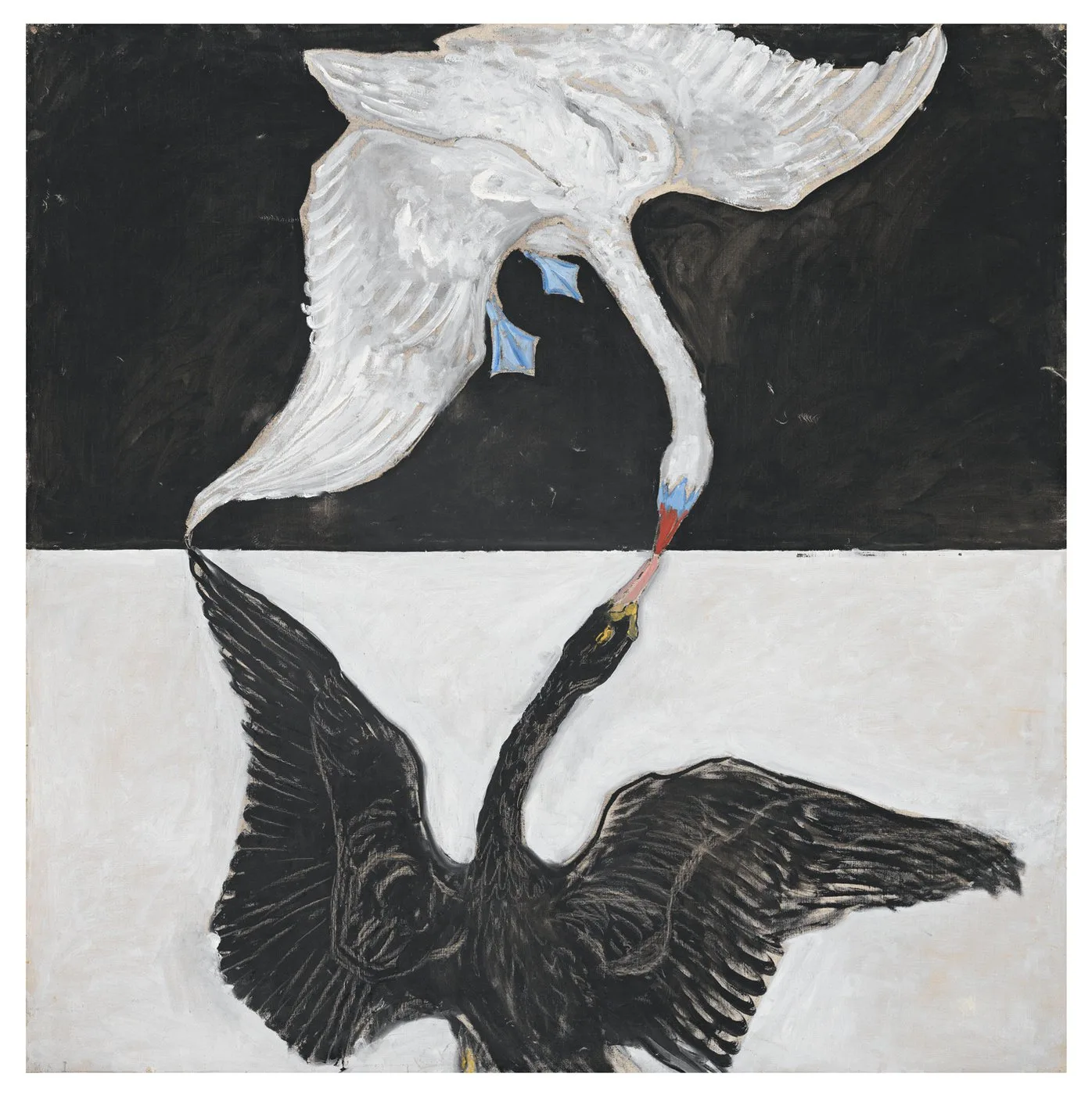
Hilma af Klint — The Swan, No. 1 Group IX/SUW, 1914–15 Oil on canvas
In her will, af Klint stipulated that her paintings should not be shown for at least twenty years after her death. She died in 1944. It was not until 1986, when one of her abstract paintings was shown in a collective exhibition in Los Angeles entitled The Spiritual in Art, that the general public saw her work for the first time. The title of that exhibition — borrowed, inadvertently, from Kandinsky's manifesto — stands as one of the more pointed ironies in recent art history.
What remains, after looking at her work, is a sensation difficult to articulate: the certainty of having seen something that did not need our attention in order to be true. In an age when everything seems to exist only in the moment it is seen, Hilma af Klint stands as a silent and perfectly intact anomaly.
History proved her right. It simply took some time.